Category: Consumer Complaints

  • How to file FIR Online?

    How to file FIR Online?

    What is the meaning of F.I.R?

    So basically the full form of F.I.R is FIRST INFORMATION REPORT. FIR is a document containing the essential details committed of a criminal offense. It should be observed that FIR is not conclusive evidence of a crime committed by an individual It is a written document or report prepared by the police based on any criminal or cognizable offense. This report is based on the information provided by the victim or any other person on behalf of the victim. FIR is the start point for an investigative process for a specific crime. A cognizable offense can be reported by anybody (who suffered from it) to the police in written or oral form. Even in some extreme cases, a victim can also report an FIR through a telephone message or can file an FIR Online.

    FIR Online

    What is the Importance of filing an F.I.R

    There are lost of importance of filing an F.I.R online some are as follows-

    1. Helps to take immediate actions
    2. You don’t have to go to the physical station
    3. Proceed the case fast
    4. No missing documents

    What is a complaint and who can file it? 

    A complaint is one where you want to report the commission or omission of an act that is an offence under the law for the time being in force.

    Therefore, any allegation made against any individual person, organization, state authority would be a complaint.

    Now the question arises as to who can file a complaint? 

    The law in our country does not necessarily require us to be the victims of an incident to file a case. This means FIRs can either be lodged by the person who is a victim or the aggrieved due to a particular incident. In normal circumstances, not all complaints need to be written, a complaint can either be oral or written Alternatively, an FIR can also be filed by a person who is not directly involved in the commission of an offence, nor is affected by it, but has witnessed it. Therefore, merely a witness to the commission of an offence has the locus standi to file a complaint, even if the actual victim does not. 

    How to present content in FIR?

    An FIR contains the following things:

    • FIR file name
    • Name of the victim, or name of the person who is filing the complaint on the victim’s behalf
    • Description of offense (facts of the incident)
    • Date, time, and location of the crime
    • Statements of witness (if any)
    FIR

    How to file an FIR (First Information Report)?

    According to section 154 of the Act Code of Criminal Procedure, 1973, the 4 step procedure is given below should be followed while filing an FIR:

    FIR Online
    • The details are written down by the police provided by the victim orally about the commission of the cognizable offense.
    • Then, the written form of the complaint must be read by the victim or the supplier of the information or makes a complaint. It is their duty and right to read the complaint recorded by the cop carefully to avoid any uncertainty in the future.
    • The person signs the complaint or puts the left thumb impression on the document (if he/she is unable to read and write) after reading it and verifying that the details that are recorded by the police are as per the information given by him/her. The sign is required to make sure that all the information provided by him/her is relevant.
    • In the end, the victim must ask for a copy of the FIR. This is also their right to have a copy of the FIR without any charges.

    What is E-FIR?

    E-fir means to file FIR online by visiting official portable. E-FIR made the system very easy and the complaints can be filed from home.

    In India, most of the population is not aware of E-FIR.


    But as we all know most of the person or complainant mainly use to go or visit police station because a large no of the population lives in rural or semirural areas which are underdeveloped and most people even today not familiar with the technology.

    Which states provide filing of FIR online?

    The following states allow filing an FIR online by the complainants. 

    • Tamil Nadu
    • Himachal Pradesh
    • Jharkhand
    • Bengaluru city
    • New Delhi
    • Madhya Pradesh
    • Haryana
    • Odisha
    • Patna city
    • Kolkata city

    The process of filing an FIR online in all these states is more or less similar, just visit their official police services website and search for the tab of filing a complaint or FIR online. Keep all your details ready and make sure you submit them correctly. 

    Significant things to bear in mind while filing FIR:

    When filing an FIR you must fill in the personal data. There will be the following options:

    • Enter the name of the complainant: fill in the name of the person wishing to lodge the e-FIR.
    • Enter the name of the father/mother: Fill out the name of the parents of the complainant.
    • Enter the Address of the complainant: full address should be entered
    • Enter the telephone number of the plaintiff: the mobile number works for the plaintiff.
    • Enter the email ID of the complainant: Email-ID is relevant as you will receive a copy of your e-FIR by email for verification.

    FIR information can’t be changed: You can’t change the contents of the FIR until you file an FIR. On the other hand, at any point afterward, you may give the police additional details.

    Online FIR in Delhi

    online FIR in Delhi

    Step 1: Open the website of the Delhi police
    Step 2: Fill in the details like your name, father\ mother’s name, address and email id, and mobile number.
    Step 3: Submit the form. See here a detailed guide to filing online FIR in Delhi.  

    How to file a fir online in New Delhi?

    • Step 1:  Go to the official website of the concerned police station. The concerned police station will be depended upon the place of incident you want to complain against. A simple Google search will give you the official website of the police station.  (For example: For Delhi Police, visit the Delhi Police official website https://delhipolice.gov.in/).
    • Step 2: Generally, on most of the police websites, on the home page there will be an option, “Service”. Search for the tag and click on it to move further in filing your complaint. 
    • Step 3: Once you click on the Services tab, there appears a drop-down with many options These are the different categories of cases. Depending upon the nature of your complaint, select the category which fits you best. 
    • Step 4: Once you select the appropriate category, you will be redirected to a new page. Here, you must fill in the details based on the nature of your complaint. Then click the Search/Submit tab. Be very careful with the details and re-check them before submitting them.
       
    • Step 5: If you have filled in all the details and submitted them, you will receive a copy of the FIR via an email at your registered email address. 

    What can you do if your FIR is not registered?

    It is illegal to not register an FIR. The remedies available are:

    1. You can meet the Superintendent of Police or other higher officers like Deputy Inspector General of Police & Inspector General of Police and bring your complaint to their notice.
    2. You can send your complaint in writing and by post to the Superintendent of Police concerned. If the Superintendent of Police is satisfied with your complaint, he shall either investigate the case himself or order an investigation to be made.
    3. You can file a private complaint before the court having jurisdiction.
    4. You can also make a complaint to the State Human Rights Commission or the National Human Rights Commission if the police do nothing to enforce the law or do it in a biased and corrupt manner.

    What is the next step after filing an FIR?

    The police conduct investigation, which may include arrests. Once the investigation has been concluded the police will record all their findings in a Challan or charge sheet. If it is deemed that there is enough proof on the charge sheet the case goes to court.

    On the flipside, after their investigations, if the police conclude that there is not enough evidence or proof that a crime has been, committed they can close the case after justifying their reasons in court. If the police decide to close the case, they are bound to inform the person who filed the FIR of their decision.

    Hope this article will help you to file an FIR online. If you are looking for a solution to the consumer complaint then you can file a complaint now!

  • How NRI can file a consumer complaint in India?

    How NRI can file a consumer complaint in India?

    Every year around 25 lacs Indians migrate overseas, which is the highest annual number of migrants in the world. Currently there are more than 30 million NRIs residing outside India. Being NRI and facing legal issues is a complicated matter and there are very limited resources to get help.

    Voxya understands the constraints of non-residents and people of Indian origin as they can not travel back and forth to India. Further they have limitations of time and resources to pursue legal matters in India.

    Many times these non-resident Indians are buying on behalf of their families in India and it becomes a nightmare if something goes wrong with the product/services they bought for their family. No one is available in India to fight for justice on their behalf and their family members are not ready to take legal action.

    In all these situations Voxya’s consumer forum platform comes to rescue. Voxya is a unique platform, helping NRIs across the globe to resolve matters relating to consumer disputes in India. In this article we will see how Voxya helps NRIs to fight for their consumer rights in India.

    Talk to a Lawyer

    If you are not sure about your rights as a consumer, then it is advisable to talk to a lawyer in India who can guide you regarding Consumer Protection laws. Voxya provides a very affordable and convenient service wherein you can request a call back from a lawyer in India in just Rs.499 only.

    If you have an active Indian phone number working in your country of residence then you can easily receive calls from a lawyer in India. However, if you do not have an Indian phone number then Voxya lawyers can even call your WhatsApp phone number for a seamless audio call.

    Start Social Campaign

    Once you are aware of your rights and have some direction to move forward, you can try using Social media to raise your voice against brands in India. This works as long as you are active in Social media and have shared your concern tagging the brand and your close friends & family.

    But if you are unable to get any resolution then it’s time to use Voxya services to get some serious help.

    File a Complaint

    Visit Voxya.com and you can easily file a consumer complaint against the brand online by using Voxya platform. The process is very easy and it takes less than 5 minutes to file a complaint. You are completely free to use either Voxya website or Voxya mobile app to file a consumer complaint against companies.

    You can download Voxya mobile app here: Download Voxya App

    However, the mobile app provides a convenience to speak and voice record your complaint by using the microphone of your mobile device. You would be required to provide complaint details along with evidence like invoice, payment receipt, picture, email screenshots etc to prove your point. But do not worry if you don’t have evidence ready as you can even attach them later after filing your complaint.

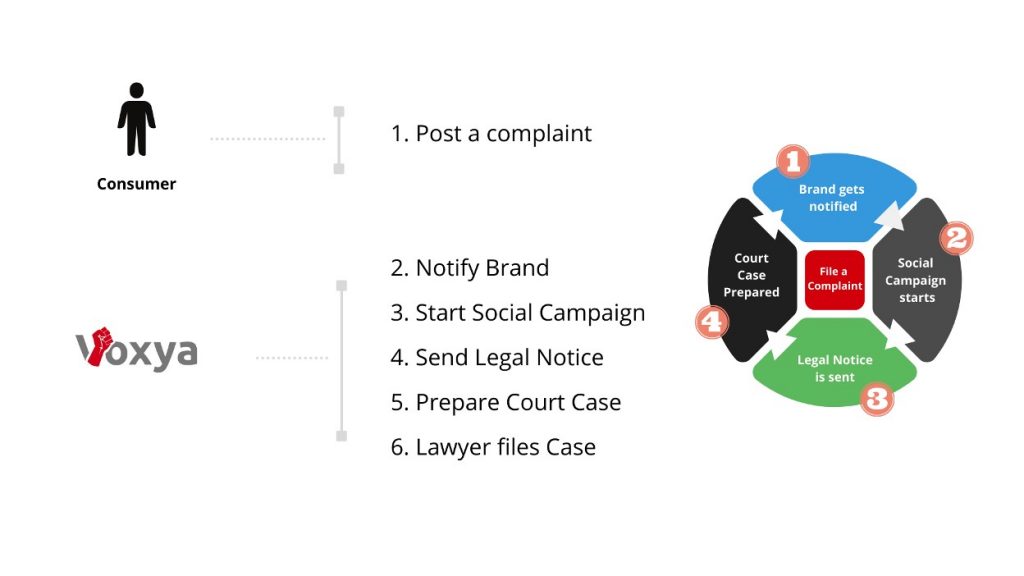
    While filing a complaint, you will be given options to choose for receiving appropriate services from the Voxya legal team. Select sending Legal Notice and Case Document preparation in order to take legal action against the brand. As Voxya fights on your behalf so you would be required to verify your identity and provide your permanent address to take legal action.

    Send Legal Notice

    Once your complaint is filed, the Legal team will prepare a Legal Notice and it will be sent to the opposite party in hard copy via registered post. You will also receive a copy of the Legal Notice at your address if you have opted for it. You would wait for 30 days after sending the notice so that they can resolve the matter.

    File a Case in Consumer Court

    If you do not get any resolution or response from the brand then the next step would be to file a case against the brand in Consumer Court. Generally speaking filing a case in Consumer Court is very easy and it does not require any lawyer. But since you are not available in India so in your case, you would be required to hire a lawyer in India who can file & fight case on your behalf.

    Also you should have some relatives or friends in India to provide Power of Attorney to file your case. The good news is that you need not search for an experienced & affordable lawyer in India because Voxya can connect you to the appropriate lawyer in its large network of lawyers. The lawyer will be there to help you in filing and fighting your case till you get a decision in your case.

    It generally takes some time in getting justice in the Consumer Court but that should not stop you because even if your case runs for 2 long years then too you will get interest on the money which you are claiming. Of course much depends upon your case details and the Court but there are chances of getting appropriate monetary compensation for time & efforts spent on case, apart from covering your legal expenses.

    So, if you are a non-resident Indian wanting to take legal action against some brand in India, File a complaint today.

    You can also Download Voxya Mobile App to file a consumer complaint with a voice record option!

  • How to get a divorce in India?

    How to get a divorce in India?

    Table of contents-

    1. Divorce in India
    2. Types of Divorce
    3. Process of divorce
    4. Indian Divorce Act
    5. Divorce Lawyer

    In India and other countries, Divorce is something big people become curious about. They have many questions regarding divorce like what things it involves, how people proceed with this, what circumstances make a couple of files a divorce, what difficulties they have to go through, and so on. So in this article, we would be talking about this topic.

    A divorce is a legal action between a married couples to terminate their marriage relationship or we can say it is a formal ending of a marriage. This generally happens when husband and wife decide not to live together or they no longer want to be married to each other. There could be many reasons for divorce like Infedility, money problems, addictions, extraordinary situations, incompatibility, irreconcilable differences etc.

    Divorce laws differ around the world but if we talk about major countries so in many countries divorce requires the sanction of a court or any other authority in this legal process, which may also involve various issues like distribution of property, child custody, alimony, parenting time, child support, division of debt etc. Divorce is different from annulment which declares the marriage null and void with legal separation. Therefore, Divorce and separation are two “different things”.

    Since India is a secular country and here wide number of religions are freely practised. Also there are major religions practised which includes Hinduism, Islam and Christianity. In these religions marriages are in accordance with their religious rituals and ceremonies. Therefore, the matrimonial laws in India are essentially governed by personal laws depending on their religion.
    Different Acts were made for this legal process in India-

    For Hindus: Hindu Marriage Act 1955

    For Muslims: Muslim’s marriages are a contract comes under Muslim law.

    For Christians: Indian Marriage Act 1872 and the Divorce Act 1869

    For Parsis: Parsi Marriage and Divorce Act 1936

    All the above laws are applied throughout India.

    divorce in India

    Types of Divorce in India

    Mutual Consent

    When both the partners are not compatible with each other, and they decide for their good to dissolve their marriage relationship, here a mutual consent divorce can be obtained under section 13-B of the Hindu Marriage Act for Hindus, Sikhs, Jaina and Buddhists.

    Although this procedure is easier than contested divorce as it is a legal process so it consumes time. If we talk about the time duration it takes, so after including all processes like counselling, settlement, documentation and two motions it may consume about 7 months in this whole process.

    Legal requirements for mutual divorce consent-

    • The couple must have been married for at least 1 year
    • The couple must be living separately for at least 1 year
    • The couple is unable to live together
    • The couple has reached the consensus to get divorced

    Contest Divorce in India

    A contested divorce in India could also be known as a one-sided divorce. A divorce petition is filed by one spouse against the other and the other spouse contests before the court. It is a formal way of filing a divorce, it is generally exercised when mutual consent divorce is not possible.

    In a contested divorce the process is longer than mutual divorce, the period may range from 3-5 years due to the complications and possibilities either party can challenge the decision in the court.

    Contested Divorce has different stages

    • Meeting with an Adviser
    • Either spouse files a petition
    • Appearance and Reconciliation
    • Counter reply from the other spouse
    • Discovery
    • Settlement
    • Trial
    • Orders
    • Appeal

    Process of divorce

    In Mutual Consent Divorce in India

    • Joint filing of divorce petition involves in the first motion
    • After filing the petition both husband and wife appear before the court to record their statements
    • The court examines petitions, documents, record statements etc and after examining these court will pass on the order for the recording of statements on a vow
    • On the first motion, the court passes its order
    • A Cooling-off period is given by the court for six months so the couple so that could rethink their decisions
    • Within 18 months of the First motion filing of second motion can be done
    • Decree of divorce passed by the court in the final hearing

    In Contested Divorce in India

    • A petition is filed by either husband or wife stating all the facts and grounds for seeking a divorce
    • After the court gets satisfied it decides to send a notice or summons the other party in the court and seeks a reply from the other spouse
    • The court may suggest reconciliation and if it fails the court will continue with the process
    • Both the parties will appear before the court on a fixed date, examination and cross-examination of witnesses and evidence will be done if any
    • Counsels from both parties will present their final arguments in the court
    • Decree of divorce passed by the court in the final earshot

    Divorce under Muslim Law

    There are two processes to seek a divorce in India under Muslim law-

    Judicial Process (The dissolution of Muslim Marriages Act, 1939)

    Under this process, Muslim women can seek divorce on the following grounds-

    • Husband’s whereabouts have not been known for at least 4 years
    • Husband failed to provide maintenance for at least 2 years
    • Husband has been sentenced to imprisonment for at least 7 years
    • Without any reasonable cause, the husband failed to comply with his marital obligations for at least 3 years
    • The Husband treated his wife with brutality
    • The husband was impotent, suffering through venereal illness or he is of unsound mind for at least 2 years

    Extra-Judicial Process

    • Talaq-i-ahasan: Under this process, the husband needs to pronounce talaq orally ‘only once’ during the period of the tuhr
    • Talaq-e-sunnat:
    • Talaq-i-hasan: Under this process the husband needs to pronounce ‘talaq’ 3 times during 3 successive period of this. Also, there should not be any sexual intercourse during these periods.
    • Ila: The husband takes an oath that he will not have any sexual intercourse with his wife for four months, and after the four months the marriage will be dissolved.
    • Talaq-i-Tafweez: Also known as delegated divorce, under this the husband delegates his authority permanently or temporarily to his wife
    • Lian: If the wife has been charged falsely with adultery then she gets entitled to seek a divorce
    • Khula(Divorce by mutual consent): If the wife agrees to give consideration to her husband to free her from the marriage, then it is considered as mutual divorce. It is the will of the wife.
    • Mubarat: If both husband and wife don’t want to continue their marriage, so the divorce can be filed by either of them and if the other spouse accepts then the marriage gets dissolved.

    Talaq-e-Biddat or triple talaq is not a valid divorce anymore. Under section 3 of The Muslim Women Act, 2019 triple talaq is considered as void and illegal. Triple talaq whether oral or written in any electronic form will be considered an illegal and non-bailable offence under this act.

    Indian Divorce Act 1869

    Indian Divorce Act 1869, this act came into existence on April 1, 1869. It applies to the entire country but the state of Jammu&Kashmir. It is one of the fewest Indian personal laws governing Christians. Since many laws have been made and applies differently to all religions, the Indian Divorce Act is also important as it affects the Christian community.

    This Act mainly contains provisions like defining powers of courts, grounds for dissolution of marriages, custody issues, etc. It only applies to the people who belong to the Christian religion and should be residents of India only.

    Grounds for dissolution of marriage

    The husband or wife must file a petition before the District court. Section 10 of the Indian Divorce Act contains grounds on which the court may dissolve a marriage.

    Following grounds

    • When either of the parties commits infidelity
    • If a party belongs to the Christian religion
    • If either of the party is of unsound mind for 2 years
    • If either of the party is suffering from venereal disease
    • If either of the party has deserted the spouse for 2 years
    • If either of the party is treating the spouse with cruelty

    Divorce by mutual consent

    Under Section-10 A, if both the husband and wife mutually agree to seek divorce then they can file a petition. For this purpose only the Parliament of India amended this Act to insert Section-10 A. Parties may file a petition for divorce in the District court. In order to file a divorce, they must have fulfilled all the above-mentioned grounds. The court may dissolve their marriage if the parties do not withdraw their petition.

    Divorce Lawyer

    Lawyers are sometimes displayed as stirring up domestic conflicts to build a fee. At best the lawyer is regarded as a necessary asset, in view of the increasing number of people involved in divorce the role of the lawyer is also increasing.
    As the lawyer helps you best in all the consequences relating to a property, marriages/relationships, child custody etc., which cannot be handled by any one of us other than the lawyer. For divorce processes approaching an attorney is the best way.

    Moreover, a divorce lawyer can serve as the go-between for you and your spouse. One can avoid personal contact to help make them easier to get through.

    A lawyer helps to get divorce in India in many ways-

    • Accounting for marital assets
    • Illustrate property division
    • Formulating a debt repayment plan
    • Determining spousal support and other privileges
    • Helping with custody plans
    • Preparation with divorce papers
    • Negotiating a settlement
    • Representing in the court

    You can contact an advocate for legal advice for a divorce case in India.

    file consumer complaint india

    If you need legal advice to win a consumer case in consumer court then Talk to a lawyer now!

  • How to check CIBIL score online?

    How to check CIBIL score online?

    Table of Contents

    The Credit Information Bureau (India) Ltd, most popularly known as CIBIL, is the primary agency that provides credit reports and scores to each user. With the help and information of the financial condition of the users from leading banks and other financial organizations in the country, CIBIL sort outs all the data and provide scores based on the data collected like previous loans history or credit card data. It was founded in 2000 and is expanding to date throughout the country. It has the support of TransUnion International and Dun and Bradstreet, the major global credit bureaus and agencies.

    What is a CIBIL score?

    A Reserve Bank of India (RBI) authorized credit agency, the Credit Information Bureau (India) Ltd, offers CIBIL scores and CIBIL reports to its users. The score is calculated using the user’s credit details. It also provides credit report services to banks and other non-banking financial companies (NBFC). A CIBIL score consists of three digits, usually ranging between 300 and 900, 300 being the lowest score that can express a person’s creditworthiness. Higher the score, the more benefits one will have. It is calculated based on your financial data from the past six months. The data is fed to an algorithm having 258 different variables, each having its importance.

    CIBIL score has its own importance, such as-

    • Higher quantum of loan
    • Easier loan documentation process
    • Flexible and extended repayment tenure
    • Lower interest rates on loan
    • Quicker loan application process
    • If you have a score between 700 and 900, you can expect up to 80% of the total cost of property for a home loan.

    And… It has its own benefits, like-

    • High credit limit
    • More chances of your loans getting approved
    • Lower interest rates for your loans

    How to check the CIBIL score?

    • Visit the official website https://www.CIBIL.com/. Click ‘get your CIBIL score’.
    • Select ‘Click here to get your CIBIL score.
    • Fill in your name, email ID, password, PIN code, date of birth, and phone number. Attach an ID proof (passport number, PAN card, Aadhaar or Voter ID).
    • Press ‘accept and continue’.
    • Fill in the OTP you receive.
    • Go to the dashboard to view your score.
    • You will be redirected to the website, myscore.CIBIL.com.

    Key points about CIBIL score

    • 750 score is considered an ideal score.
    • Credit cards and loan payments have the greatest impact on the scores.
    • Try to keep your utilization ratio at 30.
    • It is advised to get a credit card with a high upper limit.
    • Have a good balance between secured and unsecured debt (A credit card is an unsecured debt while a car loan is a secured debt).

    Range of CIBIL score

    • NA/NH – Not applicable or no history. You have never used a credit card before until this stage.
    • 350-549 – A bad score due to unable to pay the loan EMI or credit card bill on time. Lower chances of getting a loan at this level.
    • 550-649 – A fair score. Only a few lenders will grant you a loan at this stage. Interest rates will be very high on your loan.
    • 650-749 – A good score. Avoid the delay in paying the bills on time to increase your score to a higher extent. You still may not get the best offer available.
    • 750-900 – An excellent score. It indicates you pay your bills on time and brings you the best offer that a bank or credit card company can provide.

    How to improve your score?

    • Check your CIBIL score regularly
    • Monitor your score
    • Check if the previous CIBIL report has any errors in it
    • If your score isn’t more than 750, you should restrict using your card very often
    • Have a higher upper limit of your credit card
    • Complete your payments of the bills on time
    • Never pay partial amount while paying any bill

    Positively affecting factors

    • Check your score regularly
    • Avoid over-leveraging
    • Have a good balance of secured and unsecured debt
    • Maintain a low utilization of your credit card
    • Pay the credit card bills on time
    • Pay the loan EMIs before the due date
    • Never do a partial payment while paying your bills
    • Maintain a clean financial record
    • Have personal copies of the credit report
    • Check the report and make sure there are no errors

    Negatively affecting factors

    • Converting a defaulter as a guarantor
    • An irregular pattern of payments
    • Not checking your credit score from time to time
    • Not examining your report thoroughly
    • Maintaining a high credit utilization record
    • Having low or no credit record history
    • Avoid making several inquiries
    • Becoming a defaulter for not paying the bills at a time
    • Having a pile of unsecured debts
    • Closing old accounts which have a long history
    • Getting rejections for your loan multiple times
    • Closing credit card with a high upper limit
    • Requesting to increase the card limit again and again
    • Not solving the error in the reports

    FAQs

    Will opting for a credit card decrease my CIBIL score?

    If you have a zero-balance history on your previous credit card, then no need to worry, and you can close it without any issue. If your credit card with a record, then it will affect your score.

    Does zilch credit mean a good score?

    If you think ignoring loans will make your score perfect, you are very far from the truth. No loan record directly indicates no transaction records and no points awarded.

    Is it possible to check the CIBIL score without paying any fee?

    No, CIBIL requires you to pay the fees for viewing the CIBIL report. The CIBIL score can only be obtained after the payment of the fee.

    Can CIBIL score change?

    If your financial information changes, the score will also change.

    Who can access my CIBIL score?

    It can only be accessed by CIBIL members like banks, lenders, you and some authorized organizations.

    Is PAN required for checking the CIBIL score?

    PAN is required in every financial task you will do. PAN is used as the most crucial tool in differentiating all individuals.

    Can I delete or amend my credit info by myself?

    No, you cannot make any alters to the CIBIL score by yourself. If you have any issue with the CIBIL score, inform the authorities immediately after examining the CIBIL report.

    What is the minimum score required for the approval of home loans?

    The credit score/report is a part of the loan application review. The banks have the liberty to take an independent decision based on their records as well.

    For how long CIBIL keeps the record?

    Any data older than seven years is not included in the current CIBIL score or CIBIL report.

    How often are the CIBIL reports updated?

    The reports are processed every 45 days.

    Consumer Complaint

    If you are a consumer and not satisfied with the services provided by the company or the seller then you can file a complaint at Voxya, India’s trusted consumer complaint platform for resolving consumer complaints easily with an optimal solution.